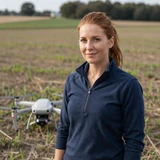
Industrial farmers dating isn't about overalls and pitchforks - it's about connecting agricultural singles who operate at the highest level of American food production. Today's large-scale farmer is a CEO, logistics coordinator, data analyst, and heavy equipment operator rolled into one. The USDA reports that farms with gross cash farm income (GCFI) above $1 million account for just 4% of all U.S. farms yet produce over 46% of total agricultural output (USDA ERS, 2024). The people running these operations deserve a dating platform that understands their world.
Consider this: modern precision agriculture involves GPS-guided tractors accurate to within one inch, drone-based crop monitoring, variable-rate fertilizer application controlled by satellite data, and real-time commodity trading on mobile devices. A farm manager overseeing 5,000 acres of corn and soybeans in Iowa isn't a "simple country folk" stereotype - they're a high-tech business professional whose office happens to have no walls.
Ag-Tech Specialists: The New Face of Farming
The agricultural technology sector reached $22.5 billion in global investment by 2025 (AgFunder). Behind those numbers are real people - precision agriculture specialists, drone operators, agricultural data scientists, equipment integration managers, and agronomists - who work 80+ hours per week during peak season and struggle to find partners who understand why a text back might take six hours.
Farming in 2026 is a high-tech, fast-paced industry. Farmers manage complex data, autonomous machinery, and navigate global markets - all while trying to find time for a personal life.
- Grace Smith, Agricultural Technology Analyst
Feedlot Managers, Grain Elevator Operators & Beyond
Industrial agriculture extends far beyond row crops. Feedlot managers overseeing 50,000 head of cattle, poultry operation supervisors coordinating with Tyson or Perdue, dairy farm directors managing robotic milking systems - these are blue collar dating candidates in title only. The reality is a professional managing complex supply chains, employee teams, regulatory compliance, and razor-thin margins simultaneously. The median farm household income sits at $102,748 per year (USDA, 2024), but for large-scale operations, revenues can reach tens of millions with net margins that fluctuate wildly based on weather, commodity prices, and global trade policy.
What qualifies as an "industrial" or large-scale farm?
The USDA classifies farms with GCFI above $350,000 as "midsize" and those above $1 million as "large" or "very large." Industrial-scale operations typically manage 2,000+ acres of cropland or equivalent livestock operations. These farms often employ seasonal and full-time workers, use precision agriculture technology, and operate as LLCs or corporations rather than sole proprietorships. About 86,400 farms in the U.S. fall into the large-scale category.
Is ag-tech a real career path in farming?
Absolutely. Agricultural technology roles include precision ag specialists ($65,000-$95,000/year), drone pilots certified for agricultural spraying ($50,000-$80,000), farm data analysts ($70,000-$110,000), and agricultural software engineers ($90,000-$140,000). The sector is growing at 12% annually (Bureau of Labor Statistics projected), making it one of the fastest-growing segments within agriculture. Many ag-tech professionals live in rural areas and face the same dating isolation as traditional farmers.